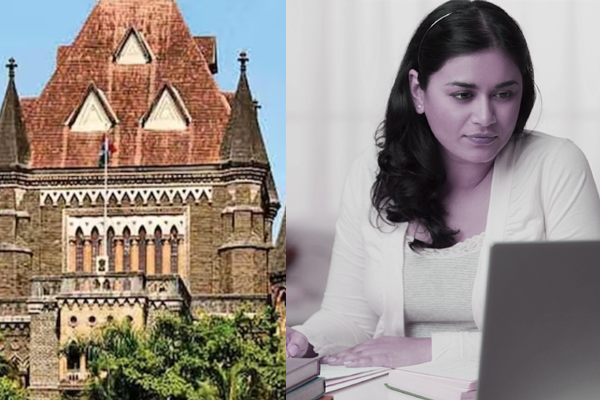
Although a working wife with a sufficient income is not eligible for interim maintenance, her child's maintenance must be paid starting on the application date: Bombay High Court
According to the Bombay High Court, a working wife who has enough money to support herself is not eligible for interim maintenance under Section 24 of the Hindu Marriage Act, 1955. Nonetheless, the Court made it clear that maintenance granted to a child must be paid starting on the application date rather than the order date.
On December 9, 2025, Justice Manjusha Deshpande gave the ruling, partially granting a writ appeal brought by Deepti Mohan Das contesting a Family Court order that had denied her support but allowed her daughter ₹15,000 per month starting on the date of the decree.
In accordance with Hindu Vedic customs, the petitioner and respondent were wed in Mumbai on December 16, 2010. On May 8, 2014, a daughter named Ananya was born. The petitioner claimed that the respondent and his family had physically, verbally, and emotionally abused her, forcing her to live apart from her parents and little daughter. She additionally claimed that the respondent had once taken the young daughter away under the guise of a summer vacation and neglected to return her custody. As a result, the petitioner filed a habeas corpus petition with the High Court, which led to the restoration of custody.
In accordance with Section 13(1)(ia) of the Hindu Marriage Act, 1955, the petitioner filed for divorce before the Family Court in Bandra, Mumbai. She also filed an interim application under Section 24, requesting maintenance of ₹25,000 for herself and her daughter, ₹20,000 for rent each month, and ₹2 lakh as costs associated with litigation. Along with their bank documents, both parties submitted affidavits of assets and liabilities.
The application was partially granted by the Family Court, which denied support to the petitioner but granted relief to the minor daughter in the amount of ₹15,000 a month starting on the date of the decree.
The petitioner challenged the order, using the Supreme Court's ruling in Rajnesh v. Neha (2021) 2 SCC 324 to argue, among other things, that maintenance should have been granted from the date of application rather than the date of the decree. She further claimed that the respondent had made a conscious effort to demonstrate financial inability by obtaining a top-up loan on his mortgaged property, taking out a car loan, and quitting his employment after learning of the divorce proceedings. To determine the respondent's ability to pay maintenance, she used bank documents that showed regular salary credits of ₹1,28,239 from UBS Business Solutions between May 2019 and May 2021.
Additionally, the petitioner contested the Family Court's negative conclusion based on a single salary credit of ₹61,596 dated May 31, 2018, which was contrasted with her claimed income of ₹43,157 in October 2010 and a salary slip of ₹32,156 for March 2022. The Family Court had noted that it was unlikely that an income could decrease so much during a 12-year period.
In opposition to the writ petition, the respondent argued that Article 227 of the Constitution's scope of intervention is incredibly narrow and only applies in situations of perversity, arbitrariness, significant irregularity, or obvious illegality. He argued that in accordance with Section 24 of the Hindu Marriage Act, the non-applicant must have sufficient income to support the applicant, while the applicant must demonstrate a lack of sufficient means for maintenance. He said that the petitioner's income from trading, mutual funds, and work demonstrated her financial independence.
The High Court determined that the writ petition's scope was limited to two questions: whether the Family Court's order contained any serious irregularities and whether a case for interference under Article 227 was established.
The Court found no basis for interfering with the petitioner's maintenance claim. It stated that the petitioner was a qualified, self-sufficient lady who worked for a reputable company as a Deputy Manager at Kotak Mahindra Bank, earning ₹28,032 per month. The Court affirmed the Family Court's finding that the petitioner's monthly salary of ₹43,157 in October 2010 could not have dropped to ₹32,156 in March 2022.
A pay credit of ₹61,596 dated May 31, 2018, while working in the same organization, threw doubt on the authenticity of the petitioner's other income claims, the Court noted, rejecting the petitioner's assertion that her compensation had decreased due to a change in employment. Additionally, the Court noted that the petitioner had enough money to support herself because her bank statements showed revenue from mutual fund investments, dividends, and share trading, including a sum of almost ₹7 lakh indicated in her ICICI Demat account.
Regarding the daughter's upkeep, the Court noted that although the petitioner claimed monthly expenses of ₹43,250, no supporting documentation, such as stationery bills or school fee receipts, was presented. The Court decided, citing paragraph 92 of Rajnesh v. Neha, that child-related costs must be divided proportionately in cases when the wife makes a sufficient income. The Court upheld the Family Court's monthly order of ₹15,000 after determining that the respondent was responsible for half of the daughter's real monthly expenses, which were estimated to be around ₹30,000 due to the tendency to inflate claims.
The petitioner's financial independence disqualified her from receiving any compensation for alternative housing or litigation costs, according to the Court.
On the matter of the maintenance's effective date, however, the Court determined that the Family Court erred in granting maintenance starting on the date of the order rather than the application date. The Court reaffirmed, citing Rajnesh v. Neha, that maintenance must typically be granted from the date of application in order to avoid deprivation of sustenance as a result of protracted litigation.
In this instance, the order was issued on December 1, 2023, nearly four years after the application was submitted on July 15, 2019. As a result, the High Court changed the contested ruling and ordered the respondent to give the daughter ₹15,000 in interim maintenance starting on the date the application was filed.
Case Title: Deepti Mohan Das v. Avinash KrishnamurthyWrit
Petition No.: 3507 of 2024